Background
NASA’s Apollo 11 mission successfully landed the first humans on the lunar surface on July 20, 1969, accomplishing a goal announced by President John F Kennedy in 1961. This was a national goal set forth to demonstrate technological superiority over the Soviet Union in the midst of a cold war. The Crew consisted of Neil Armstrong, Buzz Aldrin, and Michael Collins. Aldrin and Armstrong landed the Eagle Module in the Sea of Tranquility with less than 20 seconds of fuel remaining. This historic event was a defining achievement in the 20th-century, and it united the world, with about 650 million people watching the event live as Armstrong took his first step on the surface. However, in the 50-plus years following this event, conspiracy theories have remained persistent, and many claim it was all one big hoax
Origin of the conspiracy
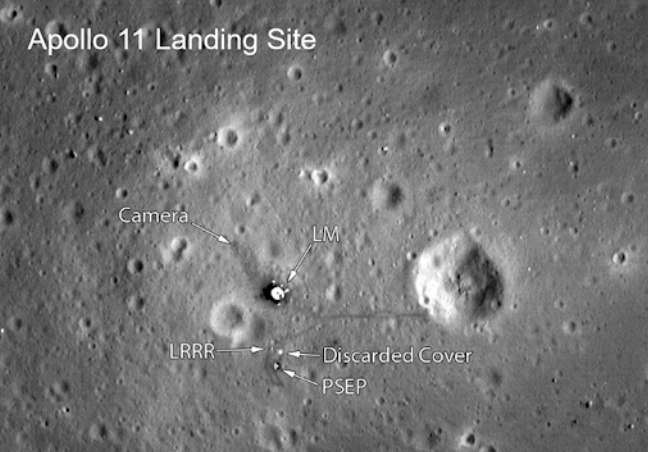
Some believe that the moon landing was faked to convince the world that the U.S. had won the “space race” against the Soviet Union. This conspiracy largely originated with Bill Kaysing’s 1976 book We Never Went To The Moon – America’s Thirty Billion Dollar Swindle, which was published during a time of increasing mistrust of the government in the post-Vietnam, Watergate era. But there are many interesting claims and “evidence” set forth, with the internet breathing new life into the theory. Some of the most often-touted questions are, “Why did the U.S flag flutter as though there was wind?” and “Why are there no stars in the background of Apollo images?” These, along with many other intriguing claims, have been proposed, but upon closer inspection, these claims fail scientifically, and there is lots of evidence that confirms the landing did occur. There are countless images, videos, lunar samples, and scientific data to prove it. In addition to the physical marks left on the Moon’s surface by the expedition.
Persuasion tactics used
There were many persuasion tactics used to spread this theory, but there were also propaganda techniques used by President Kennedy to persuade Americans to support the moon landing mission. In his famous 1962 speech, JFK used pathos by appealing to people’s sense of pride and patriotism. He used his authority and credibility to employ ethos, and he used logos by establishing a clear, challenging goal that he claimed would benefit the country, similar to westward expansion. In terms of the tactics used to spread the fake moon landing theory, the biggest ones were the appeal to distrust of government, false experts, and the big lie technique. The Vietnam War and Watergate damaged trust in U.S. institutions, which made it easier for people to believe the government could lie about the moon landing. Bill Kaysing presented himself as an engineer who worked closely on the Apollo 11 project to establish credibility, but in reality, he had no formal background in space engineering. And the Big lie technique was used to establish the idea that the lie is so massive that people assume it must be true.
Is the issue resolved?
The majority of the general public has never accepted this theory for good reason. There is simply no credible evidence that supports the fake moon landing conspiracy. There were more than 400,000 people who worked on the Apollo project for nearly ten years. A hoax requiring the involvement of this many people would be impossible to keep a secret. A recent poll found that 71% of people disagree with the hoax theory, and 17% are unsure.
Leave a Reply